2011年11月3日 星期四

劉健威談佛手柑

佛手柑 劉健威 - 2011年11月3日

近來愛上一物,佛手柑。
佛手柑皮若柑或檸檬,果實長成後巨如手掌,有十餘「指」或屈或伸,饒有奇趣,故有是名。
在西環那家賣新界蔬菜的店中看到,馬上就買下來。愛的是那既清又濃的香味,嗅了令人心寧神遠,暫去煩憂;此果據說有抗抑鬱藥效,輕嗅其氣味,便知道有道理了。
不僅香,還持久,放在家中,用水浸其榦,果實竟月不枯,清香不散。
也好看,叫金佛手亦可,因為果實通體金黃,在綠葉映襯下,十分之醒目。叫金佛手,也因產自金華,一如火腿,也有叫金腿的。
以後見了必買,還叫店家專門找來。後來發覺花墟有整盆賣的,一株樹四個金燦燦的果實,只賣二百,即買下來,放在家中露台,日日澆水,閒來聞聞香味。
記得小時,常見大人將佛手柑供奉於神枱之上。後來才知道,這是浙江赤松鄉名產,當地人視為仙果,用以供奉黃大仙;或許因此,此果常出現在神枱上了。
佛手柑不止產於浙江,雲南、四川、江蘇、廣東都有,尤以「廣佛手」質量為佳,現在買到新界出產者,就屬「廣佛手」,果實碩大、香氣濃郁。
佛手柑也不僅中國獨有,亦見於意大利,叫Bergamot,是以產地Bergamo命名。
佛手柑可作藥用,賣盆栽的女人就教我,可切下四分一個,和粟米、紅蘿蔔一起煲湯,有健脾養胃之功。
我不大理會食療,倒喜歡佛手柑那濃香的橘子味,相信用作香薰該更佳;據說製成香精的佛手柑,和薰衣草、天竺葵混合,都是絕配。
早在宋代,已有人培植佛手柑,晏殊有詩:「丹葩羔漆細馨添,蒼葉輕排指樣柔;香案淨瓶安順了,還能摩頂濟人不?」佛手柑也可製茶,但還是「香案淨瓶安順」,以「清供」為佳。

2011年6月13日 星期一

《壹週刊》- 實地測試 香薰粒放毒 超標百倍


《壹週刊》- 實地測試 香薰粒放毒 超標百倍
頭號健康
一名女子因為在家燒香拜神,遭鄰居投訴因此導致早產,於是告上法庭,上週五被判罰款七萬五兼被限制燒香。這宗新聞令人聯想除拜神香可能有毒外,燃點減壓香薰亦危機重重。本刊邀請空氣質素專家進行實地測試,發現燃點香薰產品時,釋出的揮發性有機化合物(VOC)、甲醛(HCHO)及懸浮粒子(PM)統統超標,粒狀香薰釋出的揮發性有機化合物超標一百零八倍,亂用香薰減壓辟臭味,小心反遭香氣毒殺!

四十七歲的香薰治療師Alice,十多年前因為鼻敏感久醫不癒,由朋友介紹試用香薰,覺得有幫助,所以一試上癮,「用了兩、三年,便開始研究香薰治療;平時一返工就會即刻燃點香薰,忙完一日,返到屋企,會繼續用電香薰爐點香薰,令自己更加relax。」
廿四小時索香薰
由朝聞到晚,Alice未覺有問題,「我會跟足指示用,知道蠟燭有化學物,我寧願改用電香薰爐;至於香薰油,就一定揀純天然製造的香薰油,避免用化學物製成的香精。」 不過,專業資格獲環保署認可的室內空氣質素顧問黃勁松就認為,就算用天然香薰油,都不能保證百分百安全。邀請黃勁松在一個約五百呎的住宅單位作實地測試,使用四款香薰產品,包括香薰粒、香薰枝、香薰油以及電香薰座,然後以測試儀量度燃點後釋出的揮發性有機化合物、甲醛以及懸浮粒子。 測試結果驚嚇,所有香薰產品釋出的揮發性有機化合物濃度,以香港室內空氣質素指標(卓越級)計算,全部超標一倍半或以上,香薰粒最恐怖,竟然超標一百零八倍。再比較世衞標準,所有產品所釋出的懸浮粒子數量統統不合格;近期大賣廣告的電香薰座,亦釋出超標三倍的甲醛。 點香薰本來想減壓,卻對健康造成威脅,黃勁松指出,「無論平價定貴價香薰,當中的香料和色素通常含化學成分,所以燃燒時就會產生有害物質,例如電香薰座就釋出超標甲醛;至於香薰粒,就會釋出高濃度揮發性有機化合物。」 睇落無害的香薰都如此驚人,可想而知拜神檀香更加恐怖。燃燒普通檀香釋出的懸浮粒子,較世衞標準高出三十六倍,但亦意外發現,燃點環保香時,釋出的有機化合物及甲醛竟然無超標,至於懸浮粒子則超標七倍。
實地驗毒
燃燒香薰或香燭時會釋放過百種有害物質,當中以揮發性有機化合物、甲醛以及懸浮粒子的毒害最備受關注。甲醛是其中一種揮發性有機化合物,可以致癌,並會依附在懸浮粒子上,吸入後會黏附在支氣管或肺部,引致呼吸系統疾病及增加肺癌、鼻咽癌等風險。
減排環保香
黃勁松指出,「如果在室內點多幾支香,數字分分鐘激增一倍半,可以即時誘發鼻敏感和哮喘。至於聲稱少煙少味的環保香,的確可以減少燃點時釋出的有害物質,算是意外驚喜。」 其實無論燃點香薰抑或香燭,同樣可以致癌,中大呼吸系統科主任許樹昌醫生指出,「新加坡去年一項研究顯示,每日使用香薰或蚊香的吸煙人士,患肺癌風險比無上述習慣的人士高四點六倍。」 許醫生解釋,「燃點香薰或香燭時,會釋出大量有害物質,這些有害的細微粒子會隨呼吸進入支氣管,引致頭痛、頭暈、噁心、眼睛、喉嚨不適、支氣管炎,影響中樞神經、肺、腎功能,以及增加患肺癌風險。」
拜神多 得庇佑?
香港理工大學在○四及○七年,曾先後就燃燒香燭和香薰所產生的空氣污染物進行研究。結果發現,在初一、十五期間,廟宇內錄得的一氧化氮、一氧化碳以及甲醛含量全部超標。另外,抽驗過六款檀香及三款香薰,發現大多數產品的一氧化碳和甲醛含量同樣超標,當中又以檀香揮發最多氣體,而香薰就釋出最多揮發性有機化合物。 參與研究的土木及結構工程學系李順誠教授指出,視乎空氣流通情況,污染物可以停留在室內幾小時至幾日不等,現時並無法例監管香燭質素,一般小市民難以選擇,最好改用電子香或者盡量減少燒香次數。
燒香必修
空氣質素專家教路,與其用香薰辟臭味,不如找出臭味源頭,徹底辟味;一定要用,都要緊記以下安全貼士。 開窗通風 點香薰時一定要保持空氣流通,雖然會略減香氣,但可以避免大量積聚有害物質。 油好過木 相比利用木粉製成的香薰枝和香薰粒,香薰油在燃燒時會產生較少有害物質。 質素為先 避免使用只含香料或其他化學物的廉價香薰油,毫無紓緩壓力作用之餘,更令人吸入大量有害物質。 孕婦不宜 有研究顯示,懷孕十二週前使用香薰油,有可能導致早產;除了孕婦以外,癲癇症及高血壓人士亦不宜使用。 資料提供:香港理工大學土木及結構工程學系李順誠教授、空氣質素專家黃勁松
醒你
美國South Carolina State University一項有關香味蠟燭的研究發現,燃點不同的固體香味蠟燭時,會釋放出甲苯(Toluene)和苯(Benzene),過量吸入可能引發哮喘,甚至導致濕疹和增加患癌機會。 國際癌症研究機構(IARC)在○四年已將甲醛列為最高級別的第一類 致癌物,確認甲醛除了會導致鼻腔癌和鼻竇癌外,亦有強烈證據顯示可能引起血癌。 
手持懸浮粒子測量儀的室內空氣質素顧問黃勁松發現,即使燃點一粒香薰粒,都可以釋出超過一百二十八萬粒懸浮粒子,遠超世衞標準。
Alice認為只要用電香薰爐,避開明火就夠安全,但專家指出就算貴價香薰油都可能含有致癌甲醛。

除了揮發性有機化合物、甲醛以及懸浮粒子外,測試亦包括二氧化碳和氮氧化物,不過結果未有超標。


好多人喜歡在密閉空間內燒香薰,其實吸入的有害物質不會少過拜神香,所以點香薰時最好保持室內空氣流通。

拜神香毒過香煙,中大呼吸系統科主任許樹昌醫生指出,拜神香釋放的懸浮粒子比香煙多四倍半,長期吸入絕對會增加致癌風險。

泰國曾有研究發現,廟宇中的煙霧含有可引致血癌的丁二烯,超標二百六十倍。

燃燒香薰或香燭時亦會釋出大量一氧化碳、一氧化氮和二氧化碳,令人感到頭痛、頭暈或刺眼。 

資料刊於1109期《壹週刊》

2011年4月18日 星期一

冬青 (Wintergreen)


冬青植物 - Dr. George Ku - 2011年4月16日

在2005年1月開始,大韓民國首都Seoul的中文名「漢城」,正式易名為「首爾」;這是因應其韓語名稱的發音而設定的。本來,漢城這個名稱自十四世紀末一直沿用,已有六百多年歷史;但可能因為它是直接從漢字搬過來,有人認為屬「政治不正確」,所以扭轉改以韓語為準,再就其普通話之拼音出之,乃成為「首爾」。其實追溯上去,韓語本是源自漢語,這樣子扭來扭去,沒有多大意義。尚有另一個改名的例子,牽涉到的也是一個國際大都市,改了之後,令其英語及中文的名稱兩者拉得更接近了,但其中遭到更改的,卻是前者,中文名稱保留一樣:此城市乃Mumbai,前名Bombay;中文名前後都是「孟買」,其發音與新的英文名稱更貼近。這裡的「正名」比較有理,因為以當地文字而言,Mumbai才是正確的名字,起源於印度教中漁民保護女神「孟巴」的馬拉地語名稱。在十六世紀,葡萄牙人叫這個地方做Bombaim,再在十七世紀中被英語化,改為Bombay。兩個字的發音看似有很大差異,一個是M,另一個是B,其實在拉丁語系中,這兩個音頗有混淆,所以菲律賓人說英語時也有同類口音偏頗的例子,為的是菲律賓曾受西班牙人統治。然則在Bombay時代,自須以B字為準,故此出了Bollywood這個字。
Bollywood是指印度的電影製片行業,在印度尤以孟買獨佔鰲頭,所以取孟買,加上荷里活Hollywood,從而塑造出這新字。假如當時孟買已易名,則會是Mollywood而非Bollywood矣。至於Hollywood這字本身也是地名,因為電影製作集中於此,所以成為影城的代號,其後更是喧賓奪主,人人稱「荷里活」而捨「影城」之名。Holly原是一種常綠植物,中文是「冬青」,其木色淡而堅硬,可用作木器;更因其顏色之故,可用以製造棋子,是為「白」的一方,另一方則採用Ebony黑檀木,成為「黑子」。冬青的葉在聖誕節是主要裝飾品之一,造成一個圈,掛在門上。聖誕卡中也經常以它為題材,一叢冬青葉中尚有數粒紅色的小果實。亦有人用冬青樹的樹枝連葉一起做裝飾的,在家中牆壁上懸掛,於是乃有聖誕歌Deck the Hall with Boughs of Holly,以表達節日的歡樂氣氛。
提到冬青這植物,因為想談及另一類更名副其實的冬青植物;不過這類的冬青,乃是Wintergreen,並非某一植物的專有名稱,而包括了多種在冬天也常綠的品種。例如有一個叫Pyrola的,中文的正式稱謂應是「鹿蹄草」,這也屬冬青植物之一,其內有一種「主要油」Essential Oil,廣泛用在一些藥油之中。下一篇續談。


植物主要油 - Dr. George Ku - 2011年4月18日

有一位朋友的祖上經營藥油,是好像萬金油的那一種,有家傳秘方,做出來在南洋一帶出售,當年頗有名氣。到他爸爸的一代,因為受的教育程度較高,之後成為專業人士,因此沒有繼承祖業。及至他長大,藥油生意早已不做,於是更隔膜了;但他的祖父一定要他學,因為怕失傳。他本身的職業也屬專業,而且做得不錯,所以只是把秘方藏在心裏,而沒有藉之以作為事業。我問了他藥油的牌子商標,告訴他說,好像沒有怎麼聽過。他說那是因為萬金油差不多獨佔了華南的市場,他們家則向西拓展。不少顧客來自中東一帶,買回去把這藥油用在祭壇上,作為祭品之一,之後取下來成為「靈丹」,應付各種身體不適,所以用量頗大。
藥油的確有它的好處。很多人隨身攜帶,可拿來應急,真的好像能治百病。藥油中主要成分之一屬冬青油(Wintergreen Oil),來自一些冬天的常綠植物,其中均含有甲基水楊酸(Methyl Salicylate)。植物中往往有所謂「主要油」(Essential Oil),為的是保護自己,應付一些外敵包括真菌(Fungi)、細菌(Bacteria)和病毒(Virus)。水楊酸(Salicylic Acid)能抑制細胞表面的環化加氧酶(Cyclo-oxygenase),故可以消炎和止痛;我們常用的一個「守門口」藥物阿司匹靈(Aspirin),正正就是乙醯水楊酸(Acetylsalicylic Acid)。
藥油中也用到薄荷(Menthol)。薄荷能溶解皮膚中的神經醯胺(Ceramide),從而引出一條臨時通道讓水楊酸滲透進皮膚。為什麼一些植物要在其主要油中囤積甲基水楊酸?原來真菌、細菌和病毒的表面都有一層油脂,水楊酸能啟動一個叫EDS1(全名Enhanced Disease Susceptibility 1)的機制,造出脂肪酶Lipase溶解入侵的真菌、細菌和病毒(Curr. Opin. Plant Biol., Vol.8, pp.383-389)。如果敵人太多,植物更會用一個叫杜鵑酸(Azelaic Acid)的成分盡快提升水楊酸份量(Science, Vol.324, pp.89-91)。
水楊酸不是主要油唯一撒手鐧,另有一種來自八角(Star Anise),其主要成分叫Shikimic Acid,是特敏福(Tamiflu)流感藥的骨幹分子。很多人在煮海鮮時會加紫蘇(Basil)、丁香(Clove)、鼠尾草(Sage)或香葉(Bay Leaf)等,這些香料含有一種叫丁香酚(Eugenol)的主要油,能殺死一些真菌(J. Med. Microbiol., Vol.58,pp.1454-1462)、細菌(Int. J. Cosmet. Sci.Vol.28, pp.125-133)及病毒(Phytother. Res., Vol.21, pp.1153-1158)。

2010年12月24日 星期五

香茅 (Lemongrass)


香茅美白 - Dr. George Ku - 2010年12月23日

今天的香港,差不多全世界的菜式都能吃到,有些甚至是來自十分冷門的地方,如俄羅斯和中東。回想三十多年前,外國菜的食肆寥寥可數,連日本料理都少,也沒有很多人懂得吃。七十年代中開始有越南菜。那年代的越戰令不少越南人痛失家園,流離異鄉。,能有辦法逃出來的難民,已是天之驕子,許多也不是全然貧困無依的,但其中不少委實是人生路不熟,而且拿着有限的財物,生怕坐食山崩,亟想找工作;對烹飪有心得的,開餐館做越南餐自是首選。
有一位朋友的朋友,姓冼,乃越南華僑,對越南的菜式甚有心得,也熟悉中國人口味,反正沒事做,想到不如試做這營生,也算是可以生財的工作。最先不敢投巨資,只是在家中經營,由朋友圈子做起,仗的是口碑;用今天的術語說來,乃是「私房菜」。因為價廉物美,而且別有風味。吃過的人紛紛帶新朋友到來,於是每天晚上座無虛席。他們家住在油麻地德興街一幢舊房子,名字頗風雅,叫「意廬」,於是「意廬越南菜」之名不脛而走,及後生意實在太好了,不得不在外找一個商舖正式開業,在數條街外的山林道找到一個舖位,門庭若市。
想到越南菜,是因為要談其中一個作料,叫「香茅」(學名Cymbopogon Citratus)。香茅是禾本科香茅屬,為常見的香草之一,能用於烹飪,在亞洲熱帶地方最為流行,越南是其中之一,此外,還去到遠至新加坡甚至菲律賓、台灣。因它有檸檬香氣,故又被稱為檸檬草(Lemon Grass)。
香茅是南亞菜的標準調味香料之一,既可以辟去羊肉的羶味和海鮮的腥味,亦有殺細菌、真菌和寄生蟲的作用。其中的香葉酸(Geranic Acid),有抑制「酪胺酸酶」(Tyrosinase)的功效(J. Agric. Food Chem., Vol.56, pp.597-601)。酪胺酸(Tyrosine)是身體的基本「胺基酸」之一,乃是組成蛋白質的成分。所有生物細胞中的蛋白質,都是由二十種不同的胺基酸排列和組合串連而成。酪胺酸是一個對皮膚色素有決定性影響的酵素。在機制上,酪胺酸能把酪胺酸轉為黑色素(Melanin),後者造成雀斑、黃斑、賀爾蒙斑、老人斑等。所以,吃了例如香茅這類食物,皮膚的黑色素細胞(Melanocyte)製造黑色素的能力會大大下降,皮膚便黑不起來了。另一個有此功效的日常食品是花椒,其中能抑制酪胺酸酶的成分是五羥黃酮(Biosci. Biotechnol. Biochem., Vol.68, pp.1984-1987)。

香茅補健 - Dr. George Ku - 2010年12月24日

有很多地方的名字,都是居於當地的人,一代接一代地「叫」出來的;最先由來,往往甚為粗鄙,難登大雅之堂;及後居住的人多了,慢慢地繁盛起來,有人感到其名刺耳,於是用同樣字音,把地名稍作改良。在香港這種例子多不勝數,例如「樂富」前名「老虎岩」;「吊頸嶺」改為「調景嶺」等。在台灣中部近西北之處,有一個地方叫「苗栗」,這名字來自原住民的土語,意思是平原;及後有大陸的閩南人遷入,以其名字發音與閩南語「貓狸」類似,故以此為稱號。去到清光緒年間,因為要與新竹縣分拆,也就順便改用了較為文雅的「苗栗」二字。苗栗縣經濟活動一向以農牧業為主,傳統製造業則有陶瓷。近年來工商業發展迅速,產業結構有大幅改變;並因鄰近之公館鄉生產豐富的天然氣與石油氣,故設有「苗栗技術輔導中心」;北郊的西山工業區,有長春化工苗栗廠、台肥苗栗廠等大型石化廠。在上世紀初,日本人岩元清從爪哇移植了一批香茅草來此地大量種植,開啟了台灣香茅草栽植事業。至世紀中,產量大增,並逐年增加,一年三造,價格又高,帶來驚人的財富。及至後期有人工合成的香茅油發明,這農產才式微。
由於現代人濫用「抗生素」(Antibiotics),有些細菌已對抗生素習慣了,有抗藥性,用之再不能將其撲滅,如有一種叫MRSA的「金黃葡萄球菌」(Methicillin-Resistant Staphylococcus Aureus),正是如此。在這方面,一組英國曼徹斯特大學的學者發現,香茅內的「主要油」(Essential Oil),能夠消滅MSRA(Lett. Appl. Microbiol., Vol.48, pp.387-392)。對於一些真菌,例如感染陰道的「念珠菌」(Candida Albicans),日本帝國大學的研究員發現,「香茅素」(Citral),對其「菌絲」(Mycelium)和「菌粒」(Yeast),都有抑制作用(Nippon Ishinkin Gakkai Zasshi, Vol.44, pp. 285-291)。香茅又可杜絕一些害蟲,把香茅提純一平匙加進洗衣粉,能更有效清洗床單,除去其上的塵蟎(Acarina, 蜱蟎亞綱)(Parsitol. Res., Vol.107, pp.987-992)。其中的香茅素尚有兩個補健作用:第一是抗癌。一組以色列學者發現,少至一萬分之三克提純的Citral,服後已足以迫使血癌細胞自滅(Planta Med., Vol.71, pp 484-488)。第二是止痛。一組奈良女子大學研究員在今年十一月發表論文,報道香茅素能透過抑制一個叫COX-2的生物酵素,而達到止痛之效(Biochem. Biophys. ACTA, Vol.1801, ppp.1214-1220)。

2010年9月11日 星期六

嬰孩驅風與精油


為嬰孩驅風 - Dr. George Ku - 2010年9月10

剛看到報章報道,英國前首相貝理雅擬在倫敦舉行的新書簽名會,終於取消了。這應是意料中事。上星期六在愛爾蘭都柏林出的亂子,令他不由得不面對現實,承認不少英國人對他有極大反感,他只好放棄這公開活動,公布的理由是「避免可能會對公眾造成不便」。想當天在都柏林,人們手持標語,稱他為「戰犯」(War Criminal),向他投擲皮鞋和雞蛋,擾攘了兩小時,最終他須從側門遁走。這位曾一度是極受擁戴的政客,最後「衰收尾」,淪落到被國民稱為「呃鬼」東尼(Phony Tony),把他姓氏中的字母調動,成為「大話精」(Bliar);美國的報章也不饒他,有一位《紐約時報》的時事評論員說他是美國總統的「鬈毛狗」(Poodle)。但他可仍是嘴硬,在這本名為《一段旅程》(A Journey)的回憶錄新書中,他承認有聽從布殊的指使,但否認是被人擺布(manipulated);「言聽計從」與「受人擺布」,可只是一線之差。不要說他將英國人帶往伊拉克戰場這決定是不是有做錯,單單是這種口中說要與布殊在國際上並肩挺立,實質上俯首稱臣的態度,在不少國民眼中,他已是有辱國體了。在美國本土,差不多沒有人不感到布殊無能。尼克遜與布殊,一個黯然認錯下台,另一個在一片喝倒采聲音中離任,是哪一個更丟臉?在外人看來,前者技術犯規,不容於口口聲聲「民主」、「正直」的社會,但後者手上卻帶有鮮血;不過,在他們自己的感受而言,可能布殊較能若無其事。當年最先在「水門事件」中將矛頭指向尼克遜的,是兩位在《華盛頓郵報》的年輕記者,其中一人名Woodward,現在已是客座編輯、記者中的明星。多年來他有十六本著作,最新的一本名為《奧巴馬的戰爭》(Obama's Wars),說有關阿富汗戰事,將在大約三個星期後出版,不少人拭目以待。
歷史上尚有另一位Woodward,也是十分著名,有一個家傳戶曉的「驅風劑」,專門供嬰孩服用的,正以此人為名,中文譯作「吳德物茨」。這是一個甚古老的「藥」,我小時候也吃過,相信那時代的父母都對它甚有信心,主要的作用,是令孩子能安靜下來。照理說,初生的嬰兒有母親呵護,睡醒便吃,吃飽便睡。為什麼有些還要哭個不停?首要原因,相信是腸胃不舒適,特別是當腸中有大量氣(風)的時候,令肚內絞痛。明天續談

小兒驅風水 - Dr. George Ku - 2010年9月11

懂得照顧嬰兒的父母,在其飽餐一頓之後,都會替他「掃風」,方法是扶他坐直,把手放平,在他背上來回輕掃,直至他「呃」出一口氣為止。另有一個特別為嬰兒配製的「驅風水」(Gripe Water),名為「吳德物茨」,是在十九世紀發明的,至今仍有人在用。發明者叫William Woodward,是美國人,他曾在波士頓任藥劑師學徒,後來在英國居住,繼續做藥劑營生。1851年,他發明了這藥方,能紓緩嬰兒腸胃不適,其中主要成分是茴香(Fennel) 和碳酸氫鈉(Sodium Bicarbonate)。在今天,憑細菌學和生物化學,可以清楚解釋這兩種成分的補健作用;但一個生活在十九世紀的人能設計出這個十分有效的藥水,可真是了不起。
先說碳酸氫鈉的補健作用。嬰兒的大腸,也正如成年人一般,有很多細菌結集。這些細菌的生活居所(腸),是一個暗無天日、也沒有充足氧氣供應的地方。所以,細菌只能用一個不需要用到氧氣的機制叫「醣酵解」(Glycolysis),為自己生產能量。在醣酵解的過程中,最終會有副產品「乳酸」(Lactic Acid)。此乃是對細菌有害的東西,細菌必須將其泵出,否則便會被自己造出來的乳酸殺死,這叫Acidosis。那些被排出的乳酸,自是先會去到其宿主的身體中。雖然乳酸不像胃酸那麽具腐蝕性,但總會刺激到嬰兒非常稚嫩的腸壁。在這方面,吳德物茨內的碳酸氫鈉能中和乳酸,從而紓緩不適。至於茴香,更是神來之筆。嬰兒習慣用口去認識周圍的環境,什麼東西都往口中送,不分好壞。所以,嬰兒很容易會把一些真菌(Fungi)、細菌 (Bacteria)和病毒(Virus)吃進自己的胃腸。這情況當然要正視,須將那些不速之客殺滅。但有什麼天然成分能殺死真菌、細菌和病毒?答案是可從植物取得的「主要油」(Essential Oil)。我們時常聽到服「抗生素」可殺死細菌。細菌也會攻擊植物,所以,為了自保,植物亦須製造類似抗生素的物質,這就是「主要油」,例子包括在紫蘇內的Eugenol,在迷迭香內的Rosmarinic Acid,在茴香內的Fenchone等。主要油不但能殺死細菌,例如大腸桿菌、金黃葡萄球菌(Staphyococcus Aureus)(J. Agric. Food Chem.,),還能殺死真菌(Phytother. Res., Vol.17, pp. 368-371)和病毒(Int. J. Food Microbiol., Vol.73, pp. 29-34)。

2010年7月23日 星期五

Composition and antimicrobial activity of essential oils


Composition and antimicrobial activity of essential oils from aromatic plants used in Brazil

Composição e atividade antimicrobiana de óleos essenciais de plantas aromáticas usadas no Brasil

ENVIRONMENTAL AND SOIL MICROBIOLOGY

Brazilian Journal of Microbiology

Print version ISSN 1517-8382

Brazilian Journal of Microbiology Vol.35 no.4 S緌 Paulo Oct./Dec. 2004

Adilson Sartoratto; Ana Lúcia M. Machado; Camila Delarmelina; Glyn Mara Figueira; Marta Cristina T. Duarte; Vera Lúcia G. Rehder
Centro Pluridisciplinar de Pesquisas Químicas, Biológicas e Agrícolas - Universidade Estadual de Campinas, Campinas, SP, Brasil

doi: 10.1590/S1517-83822004000300001 


ABSTRACT
Essential oils from aerial parts of Mentha piperitaM. spicataThymus vulgarisOriganum vulgareO. applii,Aloysia triphyllaOcimum gratissimumO. basilicum were obtained by steam destillation using a Clevenger-type system. These oils were screened for antibacterial and anti-Candida albicans activity using bioautographic method. Subsequently, minimal inhibitory concentration from oils was determined by microdilution method. Most essential oil studied were effective against Enterococcus faecium and Salmonella cholerasuisAloysia triphylla and O. basilicum presented moderate inhibition against Staphylococcus aureus while only A. tryphilaand M. piperita were able to control the yeast Candida albicans. The oils were analyzed by GC and GC-MS techniques in order to determine the majoritary compounds.
Key words: essential oil, medicinal plants, antimicrobial activity, minimal inhibitory concentration


RESUMO
Óleos essenciais foram obtidos a partir das partes aéreas de Mentha piperitaM. spicataThymus vulgaris,Origanum vulgareO. appliiAloysia triphyllaOcimum gratissimum e O. basilicum através de arraste de vapor em sistema tipo Clevenger. Os óleos foram avaliados quanto à atividade antimicrobiana contra bactérias e contra a levedura Candida albicans pelo método de bioautografia. A concentração mínima inibitória dos óleos com atividade positiva foi em seguida determinada pelo método da microdiluição. De acordo com os resultados, a maioria dos óleos essenciais estudados foram efetivos contra Enterococcus faecium e Salmonella cholerasuis.A.triphylla O. basilicum apresentaram inibição moderada contra Staphylococcus aureus enquanto apenas A. tryphila e M. piperita foram capazes de inibir a levedura Candida albicans. Os óleos foram analisados quimicamente por técnicas de CG e CG-EM de modo a determinar os compostos majoritários presentes.
Palavras-chave: óleos essenciais, plantas medicinais, atividade antimicrobiana, concentração mínima inibitória


INTRODUCTION
Higher and aromatics plants have traditionally been used in folk medicine as well as to extend the shelf life of foods, showing inhibition against bacteria, fungi and yeasts (17). Most of their properties are due to essential oils produced by their secondary metabolism (1). Essential oils and extracts from several plant species are able to control microorganisms related to skin (1), dental caries (7), and food spoilage, including Gram-negative and Gram-positive bacteria (14).
Many countries have maintained research programs to screen traditional medicines for antimicrobial activity, as is the case of India (2), Palestin (4), Africa (6), Honduras (19), Jordan (20), Cuba (21) and Italy (23). Plants from Brazilian biomes have also been used as natural medicines by local populations in the treatment of several tropical diseases, including schistosomiasis, leishmaniasis, malaria and fungal and bacterial infections (5). However, despite the rich flora, only data from a few plants is available, including both native and exotic species.
Medicinal plants from CPQBA/UNICAMP germoplasm collection have been studied against bacteria and the yeastCandida albicans (Robin) Berkhout ATCC 10231. Extracts, fractions and compounds isolated from Mikania laevigata Sch. Bip ex Baker, M. glomerata Sprengel, Artemisia annua L., Phyllanthus niruri L., Phyllanthus amarus Schumach. & Thonn and Achyrocline satureioides (Lam.) DC were able to control one or more microorganisms (11,12,13,24).
Aromatic plants and spices have great importance for food, cosmetics and pharmaceutical industries. Their use have taken place since ancient times, and despite many of them were substituted by synthetic ones, the demand for natural products is increasing (15). Leafs from O. vulgare L.O. applii L.O. basilicum L.O. gratissimum L.M. spicata L. e M. piperita Lvar. citrata have been used as spices and teas after drying, while the essential oil is utilized in cosmetics and pharmaceuticals. The essential oils contents in different species is influenced by genetic material, culture conditions and environment, (8) and finally, by crop and post-crop processing (22).
In the present study, the in vitro antimicrobial activity of the essential oils from eight aromatic plants used in Brazil was investigated. The levels and oil composition were characterized by gas-chromatography/mass spectrophotometrical analyses.

MATERIALS AND METHODS
Aromatic Plants
Mentha piperita L. (UEC 127.110), M. spicata L. (UEC 121.401), Thymus vulgaris L. (UEC 121.405), Origanum vulgare L. (UEC 121.409), O. applii (Domin) Borus (UEC 121.410), Aloysia triphylla (L´Hér.) Britton (UEC 121.412), Ocimum gratissimum L. (UEC 121.407) and O. basilicum L. (UEC 121.408) were chosen to the present study. The aromatic plants were collected from CPQBA/UNICAMP experimental field, between 9:00 and 10:00 am, in the first week on March, in full flowering, except to O. vulgare L. in vegetative stage.
Essential oil extraction
The oil extraction was obtained from 40g fresh plants by steam destillation using Clevenger system, during 3 h. The aqueous phase was extracted with dichloromethane (3 x 50 mL). The organic phase was dried with sodium sulphate, filtered and the solvent evaporated until dryness. The oil was solubilized in ethyl acetate for gas chromatography and mass spectrometry analysis.
Chromatography conditions
The identification of volatile constituents was conducted by gas-chromatography in Hewlett-Packard 5890 Series II (Palo Alto, CA, USA) equipment, with selective mass detector HP-5971 in the electron impact (EI) ionization mode (70 eV), injector split/splitless, capillary column HP-5 (25 m x 0.2 mm x 0.33 µm). Temperature: injector = 220ºC, column = 60ºC, 3ºC.min-1, 240ºC (7 min). Carrier gas (He) = 1.0 mL.min-1. Retention indices (RI) have been obtained according to the method of Van den Dool (26).
Microorganisms
Antimicrobial activity tests were carried out against the bacteria Pseudomonas aeruginosa (Schroeter) ATCC13388, Salmonella choleraesuis (Smith) CCT4296, Rhodococcus equi (Magnussom) CCT0541, Micrococcus luteus (Schroeter) CCT2692, Staphylococcus aureus (Rosenbach) CCT2740, S. epidermides (Winslow & Winslow) ATCC12228, Escherichia coli CCT0547, Bacillus subtilis (Ehrenberg) Cohn CCT2576, Enterococcus faeciumATCC10541 (Orla-Jensen) Schleifer and Kilpper-Balz (registered at ATCC as Streptococcus faecium),Enterococcus faecium (Orla Jensen) CCT5079 and against the yeast Candida albicans (Robin) Berkhout ATCC 10231.
Culture Media
Bacteria were assayed on Nutrient Agar (Merck, g/L): peptone from meat, 5.0; meat extract, 3.0 and agar-agar, 12.0, and C. albicans on Sabouraud Dextrose Agar (Merck, g/L): peptone, 10.0; glucose, 40.0; agar-agar, 15.0.
Inocula
Inocula for the assays were prepared by diluting scraped cell mass in 0.85% NaCl solution, adjusted to McFarland scale 0.5 and confirmed by spectrophotometrical reading at 580 nm. Cell suspensions were finally diluted to 104 UFC.mL-1 for being used in the activity assays.
Bioautography assays
Antibacterial activity tests were carried out prior by bioautography method on thin layer chromatography (TLC) plates (25). After dilution in ethyl acetate, the essential oils (3 µL at 10 mg/mL) were applied on duplicate TLC plates, and hexane:acetate (85:15, v/v) was used as eluent. Subsequently, the first plate was developed with anisaldehyde and the other one was submitted to microbiological assays. Chloramphenicol was used as positive control.
The bacterial inocula suspensions prepared as described were inoculated by pour-plate in the respective medium (1:100) around 42ºC. A 0.5 mL aliquot of 1 mg/mL trifenil tetrazolium chloride solution (TTC) was added as growth indicator. The media were transferred to the Petri dishes where the TLC plates were previously deposited. After homogenization, the cultures were incubated at 37ºC during 24h.
The oils activity against C. albicans (Robin) Berkhout was evaluated only by MIC (Minimal Inhibition Concentration) test.
Minimal Inhibitory Concentration (MIC) Tests
MIC tests were carried out according to Eloff (10), using a tissue culture testplate (96 wells). The stock solutions of the oils were diluted and transferred into the first well, and serial dilutions were performed so that concentrations in the range of 2-0.03 mg.mL-1 were obtained. Chloramphenicol or nistatin (Merck) was used as the reference antibiotic control. The inoculum was added to all wells and the plates were incubated at 37ºC during 24 h (bacteria) or at 30ºC for 48 h (yeast). Antimicrobial activity was detected by adding 20 µL of 0.5% TTC (triphenyl tetrazolium chloride, Merck) aqueous solution. MIC was defined as the lowest concentration of oil that inhibited visible growth, as indicated by the TCC staining.

RESULTS AND DISCUSSION
Oil Yield and Chemical Constituents
Oil yields expressed in relation to dry weight plant material are shown in Table 1. The highest (0.74% w/w) and lowest (0.10% w/w) yields were obtained from O. gratissimum L. and O. basilicum L., respectively.
The chemical composition of the essential oils obtained was analyzed by GC and GC-MS, which allowed identification of about 80% of oil constituents (Table 2). The main compounds from Aloysia triphylla (L´Hér.) Britton oil were geranial (21.83%), neral (17.45%) and limonene (11.03%). Thymus vulgaris L. main components were thymol (79.15%), carvacrol (4.63%) and p-cimene (3.27%). The Mentha species showed different oil composition. Linalool (51.0%), carvone (23.42%) and 3-octanol (10.1%) were identified from M. piperita L. and piperitenone oxide (94.8%) was present in M. spicata L. Thymol was the main constituent of O. applii (Domin) Borus (64.5%) and O. vulgare L. (38.0%) while eugenol was the component obtained from O. gratissimum (93.9%) and O. basilicum L. (28.1%).
Antimicrobial activity
Many microorganisms, which cause damage to human health, exhibit drug resistance due to inadequate use of antibiotics. Thus, there is a need for the discovery of new substances from natural sources, including plants. In this work, the antimicrobial activity of essential oils from aromatic species used in Brazil was previously evaluated by bioautographic assay that allows identification of oils active fractions. The trifenil tetrazolium chloride indicates cellular growth, once alive cells turn red. Thus, white spots indicate regions where the oil fraction was active. According to results the oils presented one or more active fractions against the microorganisms studied (Table 3).
The MIC was determined only for oils that presented positive results on bioautographic assays. Comparing with literature results (3) strong activity is for MIC values between 0.05 - 0.50 mg/mL, moderate activity MIC values between 0.6 - 1.50 mg/mL and weak activity above 1.50 mg/mL.
The results show a variable effect of the oils on the microorganisms (Table 3). Essential oil from Aloysia tryphila (L´Hér.) Britton was active against six of the microorganisms tested, showing the lowest MIC values (0.05 mg/mL and 0.50 mg/mL) against E. faecium ATCC 10541 (Orla-Jensen) Schleifer & Kilpper-Balz and B. subtilis (Ehrenberg) Cohn, respectively. T. vulgaris L., M. piperita L., O. gratissimum L., O. vulgare L. e O. appliiL. showed strong activity against E. faecium ATCC 10541 (Orla-Jensen) Schleifer & Kilpper-Balz (0.05 - 0.40 mg/mL) and moderate activity against S. choleraesuis (Smith) (0.60 mg/mL) and S. aureus (Rosenbach) (1.00 mg/mL). All oils studied presented moderate activity against S. aureus (Rosenbach) and B. subtilis (Ehrenberg) Cohn, except M. spicata L. which was inactive. The fact of M. spicata presents piperitone oxide (94.8%) as main component and not shows any activity allows concluding that it is not a antimicrobial compound. Finally, Aloysia triphylla (L´Hér.) Britton and M. piperita L. exhibited moderate activity against C. albicans (Robin) Berkhout (0.80 and 0.74 mg/mL, respectively).
Among the aromatic plants studied, the major constituents found were the monoterpenes linalool, eugenol and thymol. These compounds are previously known for its antimicrobial activity (9,16,18). Helander et al. (16) attributed the thymol antimicrobial action to its phenolic character, which can cause membrane-disturbing activities.
Finally, regarding to effects of the antibiotics used as positive control, A. tryphilla (L´Hér.) Britton presented MIC value lower than chloramphenicol, showing the antimicrobial potential of the essential oil.
Subsequently, bioguided fractionation will be conducted to the potential plants for identification of the active compounds. Evaluations of the oils from other medicinal plants are also being conducted.

ACKNOWLEDGEMENTS
The authors would like to thank FAPESP, SP - Brazil for financial support.

REFERENCES
1. Adam, K.; Sivropoulou, A.; Kokkini, S.; Lanaras, T.; Arsenakis, M. Antifungal activities of Origanum vulgaresubsp. hirtumMentha spicataLavandula angustifolia, and Salvia fruticosa Essential Oils against Human Pathogenic Fungi. J. Agric. Food Chem., 46:1739-1745, 1998.         [ Links ]
2. Ahmad, I.; Beg, A.Z. Antimicrobial and phytochemical studies on 45 Indian plants against multi-drug resistant human pathogens. J. Etnopharmacol., 74:113-123, 2001.         [ Links ]
3. Aligiannis, N.; Kalpotzakis, E.; Mitaku, S.; Chinou I.B. Composition and antimicrobial activity of the essential oils of two Origanum species. J. Agric. Food Chem., 40:4168-4170, 2001.         [ Links ]
4. Ali-Shtayeh, M.S.A.; Yaghmour, R.M-R.A.; Faidi, Y.R.B.; Salem K.; Al-Nuri, M.A.D. Antimicrobial activity of 20 plants used in folkloric medicine in the Palestinian area. J. Ethnopharmacol., 60:3: 265-271, 1998.        [ Links ]
5. Alves, T.M.A.; Silva, A.F.; Brandão, M.; Grandi, T.S.M.; Smânia, E.F.; Smânia, Jr.A.; Zani, C.L. Biological screening of Brazilian medicinal plants. Mem. Inst. Oswaldo Cruz, 95:367-373, 2000.         [ Links ]
6. Baba-Moussa, F.; Akpagana, K.; Bouchet, P. Antifungal activities of seven West African Combretaceae used in traditional medicine. J. Etnopharmacol., 66:3:335-338, 1999.         [ Links ]
7. Cecanho, R.; Koo, H.; Rosalen, P.L.J.A.; Park, Y.K.; Cury J.Á. Efeito do extrato hidroetanólico de Mikania laevigata sobre o crescimento bacteriano e a produção de glucamos por estreptococcus do grupo mutans. Anais da XIV Reunião Anual da FESBE, 14:290, 1999.         [ Links ]
8. Charles, D.J.; Simon, J.E. Comparison of extraction methods for the rapid determination of essential oil content and composition of basil. J. Am. Hort. Sci., 115:458-462, 1990.         [ Links ]
9. Consentino, S.; Tuberoso, C.I.G.; Pisano, B.; Satta, M.; Mascia, V.; Arzedi, E.; Palmas, F. In-vitro antimicrobial activity and chemical composition of Sardinian Thymus essencial oils. Lett. Appl. Microbiol., 29:130-135, 1999.         [ Links ]
10. Eloff, J.N.P. A sensitive and quick microplate method to determine the minimal inhibitory concentration of plant extracts for bacteria. Planta Med., 64:711-713, 1998.         [ Links ]
11. Fernandes, D.; Delarmelina, C.; Lordello, A.L.; Stefanello, M.E.A.; Duarte, M.C.T.; Noronha, B.H.S.M. Atividade antimicrobiana de Piper cernuum - Vell. Proc. XVI Simpósio Nacional de Plantas Medicinais do Brasil, Recife, FM 210, p.266. 1999.         [ Links ]
12. Foglio, M.A.; Duarte, M.C.T.; Delarmelina, C.; Silva, E.F. Antimicrobial activity of sesquiterpenes isolated from Artemisia annua L. Proc. 22nd IUPAC - Int. Symp. Chem. Nat. Prod., PPA 103, 2000.         [ Links ]
13. Foglio, M.A.; Rehder, V.L.G.; Duarte, M.C.T.; Muller, C.; Queiroga, C. L. Screening da atividade antimicrobiana de extratos e frações ativas de plantas medicinais através de ensaios bioautográficos in vitro. Libro de Resumenes – Tercer Congreso Internacional de Plantas Medicinales - Chile'99, p75, 1999.        [ Links ]
14. Galli, A.; Franzetti, L.; Briguglio, D. Attività antimicrobica in vitro di oli essenziali ed estratti di spezie di uso alimentare. Ind. Alim., 463-466, 1985.         [ Links ]
15. Guillén, M.D.; Cabo, N.; Burillo, J. Characterisation of the essential oils of some cultivated aromatic Plants of industrial interest. J. Sci. Food Agric., 70:359-363, 1996.         [ Links ]
16. Helander, I.M.; Alakomi, H.L.; Latva-Kala, K.; Mattila-Sandholm, T.; Pol, I.; Smid, E.J.; Gorris, L.G.M.; Von Wright, A. Characterization of the action of selected essencial oil components on Gram-negative bacteria. J. Agric. Food Chem., 46:3590-3595, 1998.         [ Links ]
17. Hulin, V.; Mathot, A.G.; Mafart, P.; Dufossé, L. Les proprietés anti-microbiennes des huiles essentielles et composés d'arômes. Sci. Aliments., 18:563-582, 1998.         [ Links ]
18. Karapmar, M.; Aktug, S.E. Inhibition of foodborne pathogens by thymol, engenol, menthol and anethole. Int. J. Food Microbiol., 4:161-166, 1987.         [ Links ]
19. Lentz, D.L.; Clark, A.M.; Hufford, C.D.; Meurer-Grimes, B.; Passreiter, C.M.D.; Cordero, J.; Ibrahimi, O.; Okunade, A.L. Antimicrobial properties of Honduran medicinal plants. Short communication. J. Ethnopharmacol., 63:253-263, 1998.         [ Links ]
20. Mahasneh, A.M.A.; Adel, M.A.; El-Oqlah, A.A.B. Antimicrobial activity of extracts of herbal plants used in the traditional medicine of Jordan. J. Ethnopharmacol., 64:271-276, 1999.         [ Links ]
21. Martínez, M.J.; Betancourt, J.; Alonso-González, N.; Jauregui, A. Screening of some Cuban medicinal plants for antimicrobial activity. J. Ethnopharmacol., 52:171-174, 1996.         [ Links ]
22. Paakkonen, K.; Malmsten, T.; Hyvonen, L. Drying, packaging and storage effects on quality of basil, marjoram and wild marjoram. J. Food Sci., 55:1373-1382, 1990.         [ Links ]
23. Panizzi, L.; Flamini, G.; Cioni, P.L.; Morelli, I. Composition and antimicrobial properties of essential oils of 4 mediterranean Lamiaceae. J. Ethnopharmacol., 39:167-170, 1993.         [ Links ]
24. Rehder, V.L.G.; Duarte, M.C.T.; Alves, A.; Melo, L.V.; Delarmelina C. Antimicrobial activities of extracts and isolated substances of Mikania laevigata Schultz Bip and Mikania glomerata Sprengel. Proc. 22nd IUPAC - Int. Symp. on the Chem. of Nat. Prod., PPA 104, 2000.         [ Links ]
25. Slusarenko, A.J.; Longland, A.C.; Whitehead, I.M. Convenient, sensitive and rapid assay for antibacterial activity of phytoalexins. Bot. Helv., 99:203-207, 1998.         [ Links ]
26. Van den Dool, H.; Kratz, P.D.A. Generalization of the retention index system including linear temperature programmed gas-liquid partition chromatography. J. Chrom., 11:463-471, 1963.         [ Links ]


Correspondence to
Marta Cristina T. Duarte
Centro Pluridisciplinar de Pesquisas Químicas, Biológicas e Agrícolas - CPQBA/UNICAMP
Caixa Postal 6171, 13.083-970,
Campinas, SP, Brasil
Fax: (+5519) 3884-7811
E-mail: mduarte@cpqba.unicamp.br
Submitted: April 01, 2003; Returned to authors for corrections: October 31, 2003; Approved: October 04, 2004


http://www.scielo.br/scielo.php?pid=S1517-83822004000300001&script=sci_arttext&tlng=en#nota1


2010年7月10日 星期六

Holy Basil and Sweet Basil

Holy Basil and Sweet Basil 


Tulsi (Holy Basil)


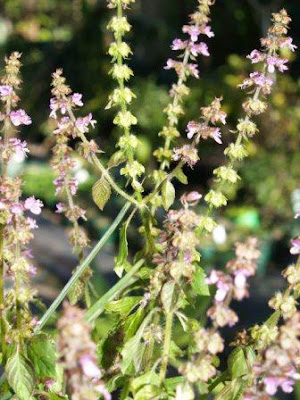
Ocimum tenuiflorum, Holy Basil (also tulsi, tulasī), is an aromatic plant in the family Lamiaceae which is native throughout the Old World tropics and widespread as a cultivated plant and an escaped weed.[1] It is an erect, much branched subshrub, 30–60 cm tall with hairy stems and simple, opposite, green leaves that are strongly scented. Leaves have petioles, and are ovate, up to 5 cm long, usually slightly toothed. The flowers are purplish in elongate racemes in close whorls.[2] The two main morphotypes cultivated in India and Nepal are green-leaved (Sri or Lakshmi tulsi) and purple-leaved (Krishna tulsi).[3]

Tulsi is cultivated for religious and medicinal purposes, and for its essential oil. It is widely known across South Asia as a medicinal plant and an herbal tea, commonly used in Ayurveda, and has an important role within the Vaishnavite tradition of Hinduism, in which devotees perform worship involving tulsi plants or leaves.

The variety of Ocimum tenuiflorum used in Thai cuisine is referred to as Thai holy basil, or kraphao (กะเพรา);[1] it is not be confused with Thai basil, which is a variety of Ocimum basilicum.

Tulsi seed
Tulsi seed is easy to germinate and grow. Sow the small Tulsi seeds in early spring indoors or in the greenhouse for an early start, or sow Tulsi seed directly in the spring or summer garden. Sow Tulsi seeds just under the surface of the soil and press in firmly. Keep Tulsi seed watered and warm until germination, which occurs within 2 to 3 weeks (faster for Kapoor). Tulsi prefers full sun, rich soil, and plenty of water. Thin or transplant to 1 to 2 feet apart. Tulsi does well in pots or window boxes, and is traditionally grown for good luck near the front door of the house.

Traditional uses: The uses of this plant are legion, and it is often taken in combination with other herbs. The fragrant leaves and flowers, in the form of tincture, tea or decoction are considered to be stomachic and expectorant, used in treating coughs, bronchitis, skin diseases, and diarrhea. These preparations are considered to be prophyllactic against epidemics including cholera, influenza and malaria. The Tulsi seeds, taken mixed in water, juice or cow's milk, are antioxidant, nourishing, mucilagenous and demulcent. They are used in treating low energy, ulcers, vomiting and diarrhea, or as an overall tonic. The powder of the dried root, taken in milk, ghee, or as a decoction, is recommended to treat malarial fever, as an analgesic application to the bites and stings of insects, and also to increase sexual stamina and prevent premature ejaculation.

Contemporary uses: Tulsi is an uplifting and energy-enhancing adaptogenic herb, having much in common with other triterpenoid containing plants such as ginseng, eleuthero and jiao-gu-lan. The herb improves resistance to stress and has a normalizing influence on blood pressure and blood sugar imbalances. Used on a regular basis as tea or tincture, Tulsi is likely to prove prophyllactic against the negative effects of environmental toxins, including cancer. The plant is also richly endowed with bioavailable antioxidants, vitamins A and C, and calcium. More information on the preparation and use of Tulsi in home herbal medicine, see the book "Making Plant Medicine."


Sweet Basil 

Basil, or Sweet Basil, is a common name for the culinary herb Ocimum basilicum (pronounced /ˈbæzɪl/ or, in the US, /ˈbeːzɪl/), of the family Lamiaceae (mints), sometimes known as Saint Joseph's Wort in some English-speaking countries.

Basil, originally from India, is best known as a culinary herb prominently featured in Italian cuisine, and also plays a major role in the Northeast Asian cuisine of Taiwan and the Southeast Asian cuisines of Thailand, Vietnam, Cambodia, and Laos. Depending on the species and cultivar, the leaves may taste somewhat like anise, with a strong, pungent, often sweet smell.

There are many varieties of Ocimum basilicum, as well as several related species or species hybrids also called basil. The type used in Italian food is typically called sweet basil, as opposed to Thai basil (O. basilicum var. thyrsiflora), lemon basil (O. × citriodorum) and holy basil (Ocimum tenuiflorum), which are used in Asia. While most common varieties of basil are treated as annuals, some are perennial in warm, tropical climates, including holy basil and a cultivar known as 'African Blue'.

Basil is originally native to India and other tropical regions of Asia, having been cultivated there for more than 5,000 years.

Basil seeds

When soaked in water, the seeds of several basil varieties become gelatinous, and are used in Asian drinks and desserts such as falooda, sherbet or Hạt é /hột é. They are used for their medicinal properties in Ayurveda, the traditional medicinal system of India and Siddha medicine, a traditional Tamil system of medicine. They are also used as drinks in Southeast Asia.

2010年3月12日 星期五

抹薄荷精油除頭皮屑當心禿頭

抹薄荷精油除頭皮屑 當心禿頭

更新日期:2010/03/12 00:07 【記者萬博超/台北報導】

有民眾在頭上抹薄荷精油去除頭皮屑,不料反而刺激頭皮發炎。中醫師袁國山指出,有民眾天天用高濃度的薄荷精油抹頭皮,想改善頭皮屑,卻反而增加掉髮,患者就醫後,才知道是精油刺激毛囊發炎。  有些民眾愛用精油保養皮膚,中醫師袁國山表示,近日就有民眾因使用高濃度精油洗頭,結果去油、去屑不成,反而因為精油屬油性,加上不少精油具一定的刺激性,同時患者皮脂腺分泌本就相當旺盛,導致毛囊出現堵塞、發炎的情形。  醫師提醒,部分民眾皮脂腺的油脂分泌旺盛,易產生頭皮屑問題,而用精油來治頭皮屑這種「以油治油」的方式並不適當,原因是未經處理的高濃度精油不建議直接使用在皮膚之上,造成皮膚毛囊過敏的反應,皮膚分泌旺盛也引起的毛囊異常,再加上油膩不溶於水的精油,也會影響皮膚健康,使頭皮和髮絲產生病態現象,最後去屑不成,反成頂上危機。  醫師說,面對這類問題,除了立即停止錯誤的精油去屑法,可在醫師診斷下以中藥改善頭皮健康不佳的情況。中醫說「髮者,血之餘也」。民眾在醫師診斷後常使用生地、龜板、海藻、當歸等藥材,促進循環,改善頭皮的健康。


2010年1月15日 星期五

Thyme oil can inhibit COX2 and suppress inflammation‏


Thyme oil can inhibit COX2 and suppress inflammation‏
For those who do not drink, researchers have found that six essential oils -from thyme, clove, rose, eucalyptus, fennel and bergamot -- can suppress the inflammatory COX-2 enzyme, in a manner similar to resveratrol, the chemical linked with the health benefits of red wine. They also identified that the chemical carvacrol was primarily responsible for this suppressive activity.

These findings, appearing in the January issue of Journal of Lipid Research, provide more understanding of the health benefits of many botanical oils and provide a new avenue for anti-inflammatory drugs.
Essential oils from plants have long been a component of home remedies, and even today are used for their aromatherapy, analgesic (e.g. cough drops), or antibacterial properties. Of course, the exact way they work is not completely understood. However, Hiroyasu Inoue and colleagues in Japan believed that many essential oils might target COX-2 much like compounds in wine and tea.
So, they screened a wide range of commercially available oils and identified six (thyme, clove, rose, eucalyptus, fennel and bergamot) that reduced COX-2 expression in cells by at least 25%. Of these, thyme oil proved the most active, reducing COX-2 levels by almost 75%.
When Inoue and colleagues analyzed thyme oil, they found that the major component -carvacrol- was the primary active agent; in fact when they use pure carvacrol extracts in their tests COX-2 levels decreased by over 80%.

Thyme growing. Researchers have found that six essential oils -from thyme, clove, rose, eucalyptus, fennel and bergamot -- can suppress the inflammatory COX-2 enzyme, in a manner similar to resveratrol, the chemical linked with the health benefits of red wine. (Credit: iStockphoto)
ScienceDaily (Jan. 14, 2010) - http://www.sciencedaily.com/releases/2010/01/100113122306.htm
COX-2 selective inhibitor is a form of Non-steroidal anti-inflammatory drug (NSAID) that directly targets COX-2, an enzyme responsible for inflammation and pain. Selectivity for COX-2 reduces the risk of peptic ulceration, and is the main feature of celecoxib, rofecoxib and other members of this drug class. COX-2 selectivity does not seem to affect other adverse effects of NSAIDs (most notably an increased risk of renal failure), and some results have aroused the suspicion that there might be an increase in the risk for heart attack, thrombosis and stroke by a relative increase in thromboxane. Rofecoxib (commonly known as Vioxx) was taken off the market in 2004 because of these concerns.
Know more COX-2 inhibitor - http://en.wikipedia.org/wiki/COX-2_inhibitor

2009年10月19日 星期一

黑斑的治療


黑斑(肝斑) - 台大皮膚部衛教單018
台大醫院皮膚部

黑斑即是俗稱的「肝斑」(melasma,chloasma),典型的表現是中年女性在兩側臉頰,可以看到整片的淡棕色至黑灰色斑。 因為顏色近似煮熟的食用動物肝臟,所以稱為「肝斑」。 大家常因肝斑這個名詞而誤以為是肝機能不好引起的,事實並非如此。黑斑是屬於表皮性黑色素增加,中年有色人種女性過三十五歲後,如未做好防曬工作,就很容易發生。此外,口服避孕藥或懷孕也很容易發生黑斑。因此,體質因素、荷爾蒙及陽光照射影響著黑斑的發生。

由於陽光照射是影響黑斑發生及惡化的重要因素,黑斑一旦發生,首要之事就是做好防曬工作。正確而有效的防曬。平日出門使用SPF25以上(防紫外線B)及PA++以上(防紫外線A)之同時可防紫外線A及紫外線B防曬乳液,外加戴帽子,打傘及穿長袖衣服。夏日上午十時至下午二時之間陽光最強,此時任何防曬措施的效果都極為有限,應避免出門。

下一步就是選擇有效﹑刺激性小的治療方法。目前常用黑斑治療的方法有﹕
• 外用退斑藥物:以對苯二酚(hydroquinone)﹑趜酸(Kojic acid)、杜鵑花酸azelaic acid)﹑熊果素(arbutin)﹑左旋維他命C (L-ascorbic acid)及維他命A酸(retinoic acids)。其所應用的原理是經由抑制抑制酪胺酸脢(tyrosinase)來抑制黑色素的形成。維他命A酸則兼具有去除角質,而加速舊的黑色素由角質層剝落的作用。目前熱門話題的三合一藥品是對苯二酚、維他命A酸及弱效類固醇。

註:關於杜鵑花酸,可參閱進一步的介紹
同時抗痘淡疤、美白退斑的藥物--杜鵑花酸(azelaic acid)
http://tw.myblog.yahoo.com/skindr-wang/article?mid=2242&prev=-1&next=2239

• 維生素C導入法:維他命C本身是極不穩定的,左旋維他命C為發展出的穩定結構。由於離子導入機及超音波導入機機器的進步,可經由導入的方式,利用微弱的電流或用超音波將穩定的維他命C(左旋維他命C)確實導入皮膚中,使維他命C的經皮吸收率便會增加數十倍之多。

•  果酸換膚:果酸換膚使用20%~70%的高濃度果酸溶液﹐去除角質,而能加速舊的黑色素由角質層剝落。醫療通路的果酸乳液(濃度10%以上)次之,市售果酸因濃度較低需要較長的時間。

•  美白保養品:衛生署核可的主要有麴酸(kojic acid)、維他命C(vitamin C)和熊果素(arbutin)的成分,這些主要是用來減少黑色素的生成。

在使用上述的處理方法時,必須注意的是如果有任何皮膚紅、腫、脫皮的現象,就應立刻停止使用並去看皮膚專科醫師。因為皮膚紅、腫、脫皮,都會使黑斑惡化。維他命A酸、果酸、趜酸、對苯二酚都有可能造成皮膚紅、腫、脫皮,因此應在皮膚專科醫師的指導下使用。以紅寶石雷射治療黑斑,反會使黑斑惡化,因此不建議使用。

總言之,黃種人中年女性很容易發生黑斑,做好防曬工作是預防的不二法門。如經皮膚專科醫師診斷為黑斑(肝斑),則應積極做好防曬工作。然後在皮膚專科醫師的指導下,使用去斑藥物、或輔以左旋維他命C導入、或搭配果酸換膚,是治療黑斑的正確方法。


黑斑的治療------馬偕紀念醫院皮膚科 吳育弘醫師 http://www.mmh.org.tw/taitam/derma/Main/07-education/Teach%20files/hyperpigmentation.html

黑斑治療的原則﹕ 
1. 確定黑斑的種類與深淺。 
2. 正確而有效的防曬。 
3. 選擇有效﹑刺激性小的治療方法。 

目前常用黑斑治療的方法有﹕ 
~ 美白化妝品 
~ 外用退斑藥物 
~ 維生素C離子導入法 
~ 化學換膚 
~ 果酸換膚 
~ 鐳射治療 


1. 確定黑斑的種類與深淺。
第一步要先確定斑的種類, 以決定治療的方式。大部份皮膚科專科醫師可由視診來診斷
黑斑的種類。

分類: 位於表皮層﹐淺的黑斑 
種類 : 雀斑﹑肝斑﹑曬斑﹑咖啡牛奶斑 外用退斑膏﹑
治療方式: 美白產品﹑維生素C離子導入法﹑果酸換膚﹑化學換膚﹑鐳射治療等再配合
防曬措施 

分類: 位於真皮層﹐深的黑斑
種類 : 部份的肝斑、顴骨斑﹑固定型藥物疹﹑發炎後色素沉著症﹑太田母斑 
治療方式: 鐳射配合防曬措施

分類: 與黑色素無關的色素沉澱
種類 : 刺青﹑重金屬沉澱﹑藥物造成的色素沉澱 
治療方式: 鐳射分解色素

分類: 其他
種類 : 痣﹑老人斑
治療方式: 視深淺可用化學換膚或電燒﹑手術﹑鐳射

P.S.>黑斑若診斷錯誤﹐使用不合適的方式治療﹐往往事倍功半。


2. 正確而有效的防曬。

紫外線的種類﹕紫外線依波長的不同分為UVA(320-400nm﹐長波)﹑UVB(290-320nm﹐中
波)﹑UVC(200-290nm﹐短波)﹐UVA比較不會造成皮膚的灼傷﹐但會持續造成皮膚變黑﹐
UVB則很容易造成皮膚的灼傷﹐大部份的UVC在經過臭氧層時都被過濾掉了。

~ 紫外線的好處﹕促使皮膚合成維生素D﹐可消滅一些皮膚表面的有害病原菌。 
~ 紫外線的缺點﹕造成曬傷﹑皮膚癌﹑加速皮膚老化。目前認為紫外線的缺點多於優點
﹐由其在黑斑的治療上﹐防曬是必須的工作 

P.S.>沒有正確而有效的防曬﹐任何黑斑的治療都是無效的。


防曬成份
在防曬乳液的成份中可簡單分為化學性防曬及物理性防曬成份﹐它們對紫外線的防止範
圍不同﹕

化學性防曬成份﹕
以吸收紫外線來達到防曬的功效﹐如下﹕ 

成份: para-aminobezoic acid (PABA) 
防止範圍: UVB 
註: 過去最常用﹐但有些人會過敏 

成份: PABA ester (Padimate-O) 
防止範圍: UVB   

成份: benzophenone 
防止範圍: UVA﹑UVB 
註: 只吸收部份UVA 

成份: cinnamates 
防止範圍:UVB 
註: 部份也有吸收UVA 

成份: salicylates 
防止範圍:UVB   


物理性防曬成份﹕
以反射﹑散射紫外線來對UVA及UVB的產生防曬﹐對UVB及UVA都有很好的防曬作用。但擦
起來較厚﹐皮膚可能較不舒服﹐如下﹕

成份﹕zinc oxide(ZnO)
防止範圍﹕UVA﹑UVB

成份﹕titanium dioxide(TiO2)
防止範圍﹕UVA﹑UVB

成份﹕red petrolatum
防止範圍﹕UVA﹑UVB


混合型﹕
混合化學性防曬及物理性防曬﹕混合化學性防曬及物理性防曬物質以達到防止UVA﹐UVB
的效果。


防曬係數(Sun Protecting Factor, SPF) 
防曬係數是指一個人塗抹防曬物質後紫外線將皮膚曬紅的劑量與沒有塗抹防曬物質後紫
外線將皮膚曬紅的劑量比。主要針對UVB造成的皮膚傷害,每塗抹防曬係數1的防曬乳液
﹐可延長皮膚被曬紅的時間1倍。
~ 膚色會影響對紫外線的抵抗力﹔白人 < 黃種人 < 黑人﹐因此建議不同的係數的防曬
乳液﹐白人(15~30)﹐黃種人(8~15)﹐黑人(4~8)。
~ 一天內不同時間的太陽紫外線強度不同﹐中午(10~14時)最強﹑清晨及傍晚較弱﹑晚
上不須使用防曬乳液。
~ 不同季節及天氣下太陽紫外線強度不同﹐可參考紫外線指數報告。
~ 防水性好的防曬油不易被汗水洗去﹐效果較好﹐但較油膩﹐適合運動﹑游泳用﹐保養
性的防曬乳液可每天用﹐但須視流汗程度適時補充。


紫外線指數(UV index﹐UVI)
紫外線指數報導前一天中午陽光最強的一個小時中(約11:30~12:30)紫外線的強度。
紫外線指數分成微量(0~2)、低量(3~4)、中量(5~6)、過量(7~9)、危險(10以上)幾個等
級,太陽紫外線愈強,紫外線指數的數字也愈大。

紫外線指數﹕1~2 
級數﹕微量 
防護措施﹕帽子﹑洋傘 

紫外線指數﹕3~4 
級數﹕低量 
防護措施﹕帽子﹑洋傘﹑防曬乳液(早上一次) 

紫外線指數﹕5~6 
級數﹕中量 
防護措施﹕帽子﹑洋傘﹑防曬乳液(早上一次)﹑太陽眼鏡 

紫外線指數﹕7~9 
級數﹕過量 
防護措施﹕帽子﹑洋傘﹑防曬乳液(早上及中午各一次)﹑太陽眼鏡﹑長袖衣物﹑儘量待
陰涼處 

紫外線指數﹕10~15 
級數﹕危險 
防護措施﹕帽子﹑洋傘﹑防曬乳液(早上及中午各一次)﹑太陽眼鏡﹑長袖衣物﹑儘量待
陰涼處﹑10~14時避免外出 

防曬工作要點﹕ 
~ 選擇同時對UVA及UVB均有防曬功能的防曬乳液或防曬霜。 
~ 看自己的膚色選擇足夠的防曬係數。 
~ 看自己的膚質(油性﹑中性﹑乾性)來選擇不同基劑及防水性的防曬乳液或防曬霜。

~ 依工作性質﹑每日可能曝曬的時段及時間及不同季節紫外線指數的高低決定使用次數
。 
~ 運動游泳時使用防水性好的防曬油﹐與平時保養所用的防曬乳液不同。


3. 黑斑的治療﹕ 

要減少的黑斑形成有幾個方法﹕
(1) 阻止新的黑色素生成
(2) 加速舊的黑色素由角質細胞內剝落
(3) 破壞黑色素細胞

外用藥物﹕ 
阻止新的黑色素生成及加速舊的黑色素由角質細胞內剝落。
外用藥物可由自己塗抹或離子導入法治療。
屬於美容常見的的退斑成份有﹕vitamin C derivatives(維它命C衍生物)﹑kojic 
acid(趜酸)﹑arbutin(熊果素)﹑mulberry extract(桑椹萃取物)﹑licorice extract(
甘草萃取物)等。
屬於藥物的退斑藥物有﹕hydroquinone(對苯二酚)﹑tretinoin(維它命A酸)﹑azelaic 
acid(杜鵑花酸)﹐這些不應出現在一般美白保養品中。

維生素C離子導入法
離子導入機是過去醫學界就廣為使用的方法,但受到機器及導入藥品的限制,效果一直
有限,目前由於機器的進步及發展出左旋維生素C的保存方法,因此可經由此離子導入
美白機將利用微弱的電流將維生素C確實導入皮膚,使維生素C的經皮吸收率便會增加數
十倍之多。
維生素C進入皮膚後,可抑制黑色素的形成,可用來治療肝斑及發炎後色素沉著症(如鐳
射治療後、燙傷後、蚊蟲叮咬後的色素疤痕)。此外還可去除細的皺紋,刺激膠原纖維
再生,使膚質改善。

化學換膚
使用trichloroacetic acid(TCA, 三氯醋酸)﹑phenol等以破壞黑色素細胞。
主要用於表淺的黑斑如曬斑﹑肝斑﹑雀斑﹑早期的老人斑﹑表淺的痣等﹐對於位於真皮
層中的顴骨斑﹑太田母斑等效果不大。
由於刺激性大﹐復原時間長(超過一星期)﹐因此目前大多用於局部小面積黑斑的處理。


果酸換膚
使用20%~70%的高濃度果酸溶液﹐加速舊的黑色素由角質細胞內剝落。
復原時間短(約2~3天)﹐但一個完整的療程須4~6次。
由於果酸本身並不會抑制黑色素的生成﹐也不會破壞黑色素細胞﹐因此較溫和﹐但只對
表淺的肝斑有效﹔對有黑色素細胞增生的曬斑﹑雀斑效果不大。
果酸還有讓皮膚膚質細緻﹑光滑﹑減少細紋的額外功效。

鐳射治療
根據斑的深淺及性質使用不同種類的鐳射﹐好的鐳射可選擇性破壞黑色素細胞或使色素
分解﹐而不會破壞其他正常組織。

鐳射有許多種類﹐常用於治療黑斑的鐳射有﹕
二氧化碳鐳射﹕用於痣﹑老人斑的去除。
銣雅鉻鐳射﹕對於表皮層或真皮層的黑斑均有效。
紅寶石鐳射﹕對於表皮層或真皮層的黑斑均有效。
紫翠玉鐳射﹕對於表皮層或真皮層的黑斑均有效。

P.S.>鐳射治療後﹐部份病人會出現發炎後色素沉澱﹐約半年內會消除。